On AI-ified digital junk
We should never, ever, confuse “can” with “should” in any design decision making process. Every design decision should be responsible towards excess.
Thu Feb 19 2026My barber mentioned something today while I was getting a haircut: an AI-powered chessboard that moves the pieces for you. He wasn't selling it or criticising it, just saying it offhand, as if this is simply where things are heading now.
Chess has always felt like one of those rare things that ask almost nothing from the world. It resists convenience. It teaches presence, patience, consequence. It is a game of stillness, of contemplation. It is a game that asks you to slow down, to think, to feel. It is a game that rewards care and attention. It is a game that has survived for centuries without needing to be “improved” by technology.
Technology will always outrun judgement. It moves faster than our moral reflexes can catch up. The moment something becomes possible, industry rushes to make it real, rarely stopping to ask whether it should exist at all. Dieter Rams saw this coming decades ago. He warned that design was drifting from responsibility toward excess, from care toward novelty for its own sake.
Rams wasn't anti-technology at all. He worked at Braun, surrounded by engineers. What worried him was the loss of restraint, that once new capabilities exist, industry rushes to use them without pausing to ask whether they improve human life in any durable way. Every automation carries a cost, even if hidden. Automation for its own sake already looked suspicious to him in the 70s. Today's AI-ified objects are just that instinct on steroids.
Objects should quietly educate their users. They shape behaviours and habits, whether we notice it or not. A quiet object teaches care and respect; a loud one teaches impatience and disposability. When you mechanise something as contemplative as chess, it's not a technical shift, it's a moral issue. The object starts to whisper that human touch is inefficient, that stillness should be “optimised” away.
Sustainability, too, should have never been an afterthought. Rams said long ago that anything unnecessary is already a form of waste. Sustainability should sit at the ethical baseline of design, not be tacked on later as marketing language. To design anything responsibly means to begin from restraint, from a refusal to make more than the world can bear.
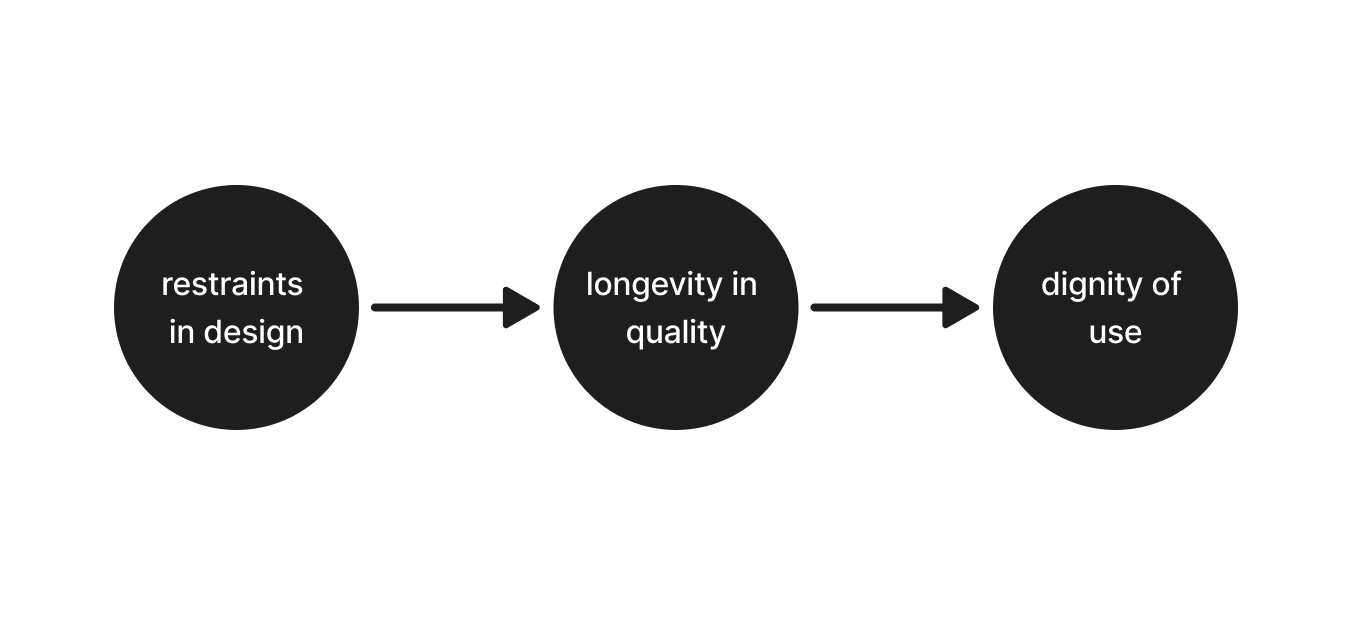
Good design disappears. It allows the user, the experience, and the meaning to emerge. Bad design demands attention, it shouts, it performs, it insists on being noticed. That's what many “smart” objects do now: they fill the silence they don't trust.
Sometimes, the most thoughtful thing we can do is to recognise that nothing needs to be added. We should never, ever, confuse “can” with “should” in any design decision making process. Every design decision should be responsible towards excess.